The Sydney Morning Herald
For decades, Bondi’s festival of lights celebration has been held in the same spot on the first night of Hanukkah. It’s loved by many, but especially by children. On Sunday, there were bubbles, kosher hot dogs and a climbing wall. Little fingers were sticky with jam from boxes of free doughnuts, which are given out to commemorate the miracle of the oil in the temple.
With five children of his own, the host, Rabbi Eli Schlanger, knew how to throw a kid-friendly party. But Schlanger was adored by everyone. Children, their parents and their grandparents greeted him joyfully as he weaved his way through the crowd, which was growing in anticipation of the main event at 7pm – the lighting of the giant menorah candelabra.
After a difficult few years for Australia’s Jewish community, there was a sense of hope. Hanukkah is about the triumph of light over darkness. “The war is over, the hostages are returned, there was a feeling in the community of a new start,” said one attendee, speaking anonymously because they are still traumatised by Sunday night’s attack. “We hoped for a calm, peaceful 2026.”
Hope had not erased realism, however. Threats from people who hate Jews are ever-present. The Bondi event, like the other Hanukkah celebrations, was not publicly advertised; details were shared by word of mouth, or within closed online communities. Local police were there, as was the Jewish community’s security firm, CSG. The festival was ringed by a makeshift metal fence.
At about 6.40pm, as the crowd reached its peak before the menorah ceremony, there was a popping noise. At first, there was confusion. But “[the pops] kept ringing, they kept firing, they didn’t stop,” said the attendee. As the danger dawned, the crowd scrambled in all directions, screaming. The fence was torn apart. Some threw themselves beneath cars, covering their children’s bodies with their own. Some ran into strangers’ apartments. Some hid in the surf club.
Fashion designer Pip Edwards took shelter under a van. “[We] watched the gunman’s feet with his gun pace in front of the van right at our heads,’” she said on Instagram. “They shot at everything and everyone; surrounding cars were being hit, including our van. I was convulsing with fear, trapped, thinking this was it for us, just monitoring the movement of their feet … we were there for 15 minutes in complete panic, shock, almost frozen, couldn’t breathe because we didn’t want to be heard.”
Jacqui Cohen was attending a bar mitzvah nearby. “The thing that alerted me that there was a problem was the sheer number of people rushing towards us, rushing out of the way – you could see there was something very wrong happening and we needed to take action,” she said. She hid in a bathroom with her daughter, alongside a child who couldn’t find their parents.
One man, who did not want to be named, felt a strange sensation on his back and thigh as he ran. “It felt like being shot by a paintball,” he says. He joined those barricaded inside the surf club, where children were bleeding and crying. He realised he was bleeding, too. He’d been hit – by a bullet, or shrapnel, he’s still not sure. “It was pure chaos,” he said. “Fear on fear.”
The two men who unleashed this terror were a father and son. Naveed Akram, 24, and his father, Sajid, 50, lived in a red-brick suburban home in Bonnyrigg, near Liverpool. Naveed, the eldest of three children, had attended Cabramatta High.
The men told their family they were going on a South Coast fishing trip. Instead, they rented a room in a short-term rental in Campsie. Police say they owned six weapons. They took four of them to Bondi. One appears to have been a high-powered, bolt-action rifle which can shoot at distance with deadly accuracy, and another a pump-action shotgun, which sprays out pellets and is most dangerous at close range.
CCTV shows the men leaving Campsie at 5.17pm on Sunday. They parked a silver hatchback in the Bondi Beach car park, which was later found to contain an improvised explosive – described as a pipe bomb – and, reportedly, an Islamic State flag.
Witnesses say the men appeared on the bridge at Bondi soon after 6.30pm. They began shooting towards the Hanukkah festival. Naveed shot his rifle from the bridge, while Sajid ran down the steps and shot from the edge of the car park. In an act of heroism likely to have saved many lives, Ahmed al Ahmed – a tobacco shop owner originally from Syria who was visiting Bondi with his cousin Josay Aklanj – tackled him from behind, snatching the gun from his arms.
Seconds before his heroic act, Ahmed turned to Aklanj. “I’m going to die,” he said. “Please see my family and tell them that I went down to save people’s lives.” His courage has earned him global acclamation.
“A very, very brave person,” said US President Donald Trump. Eventually, Sajid was shot dead and Naveed arrested after they engaged in a dramatic gun battle from the shelter of the pedestrian bridge. He remains in custody but has not yet been charged.
Their terror spree lasted for less than 10 minutes, but will have far-reaching consequences. Witnesses describe carnage. “An absolute massacre,” said a man who moved to Sydney after surviving the 2023 attack on Israel by Hamas. “I saw children falling to the floor.”
International student Rahemath Pasha said “it was the first time I saw human killing in front of my eyes”. Another man, with his head in his hands, said: “I was covering bodies.”
Vladimir Kotlyar, a Jewish chaplain for the State Emergency Service, covered his grandson with his body. The man next to them was shot and slumped on top of him. Kotlyar’s shirt and hands were covered in blood. “This is not the Australia I know,” he said.
The man with gunshot wounds limped back from the surf club and surveyed the scene. “There were body bags being put onto people, there were kids crying,” he said. “It was the most beautiful sunset. The backdrop was mayhem.” As they waited for ambulances, surf lifesavers used their boards as makeshift stretchers. As the light faded and dozens of ambulances and police cars lined Campbell Parade, the lifesavers washed the blood off with hoses.
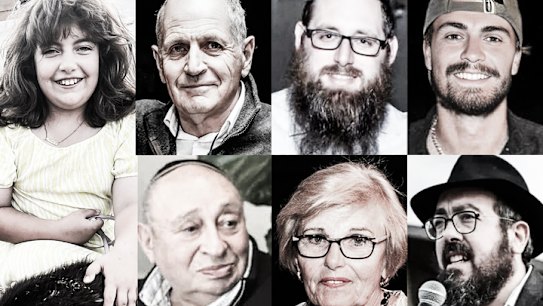
So far, 16 people have been killed, including Sajid. Schlanger, the beloved local rabbi described by friends as “the most caring, genuine, friendly person you could ever come across”, is among them. So was a 10-year-old known only as Matilda, who had been playing with the animals at the petting zoo moments before. Holocaust survivor Alex Kleytman died shielding his wife from the bullets. French national Dan Elkayam, grandfather Tibor Weitzen and former police officer Peter Meagher were also among the victims.
Dozens were injured, including two police officers – a constable and probationary constable. One is in a critical condition at St Vincent’s Hospital, and another, reports Nine News, has undergone surgery to his shoulder and may lose sight in an eye.
At around 9.30 on Sunday night, Verena Akram was at home in Bonnyrigg with her two younger children. She watched through the window as a crowd gathered in her street. She said she didn’t know why. She thought her husband, (who came to Australia on a student visa in 1998 before transitioning to a partner visa in 2011) and son had gone on a fishing trip to Jervis Bay. She’d spoken to Naveed that day; he’d told her he had been swimming and scuba diving and would spend most of Sunday inside because of the heat.
Her son didn’t have a gun, she told this masthead in a phone call. “He doesn’t even go out. He doesn’t mix around with friends. He doesn’t drink, he doesn’t smoke, he doesn’t go to bad places … he goes to work, he comes home, he goes to exercise and that’s it.” He had worked as a bricklayer, she said, but had been laid off a few months ago when the company became insolvent.
But Naveed’s history was complicated. On Monday, Prime Minister Anthony Albanese said he had been examined by ASIO due to his involvement with other persons of interest in 2019, but the investigation found he posed no ongoing threat. Sajid Akram has held a NSW gun licence since 2015. In the months ahead, ASIO and NSW Police will face questions about whether they could have done more to share information and withhold his gun licence.
By 10.30 on Sunday, officers from the Public Order and Riot Squad had cordoned off the home. At 11.30, officers marched three people down the front stairs, including a middle-aged woman, under the glare of floodlights. Helicopters circled overhead. In the early hours of Monday morning, police descended on Brighton Avenue in Campsie, where the men were alleged to have been staying. Officers combed the house throughout the day and removed evidence bags containing two long guns.
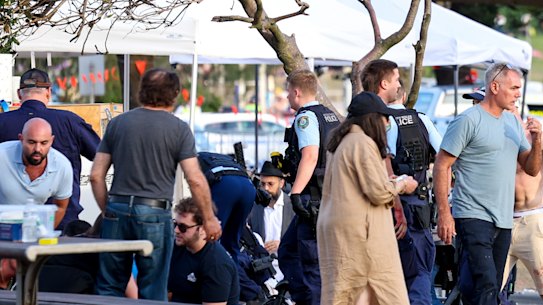
Until the wee hours, the bodies at Bondi lay where they fell. By daybreak, as Australia woke to news of its most deadly mass shooting since Port Arthur almost 30 years ago, the massacre site – still a crime scene as investigators combed for evidence – had become a makeshift memorial. There were flowers and trinkets. The Red Cross handed teddy bears to children. Flags flew at half-mast at Bondi Pavilion.
Belongings that were abandoned during the ferocious attack were lined up beside the beach, waiting for their owners – neatly arranged shoes, a football, a water bottle, some goggles, a kite. They were relics from a more innocent age. An age that had ended less than 24 hours before, when terror spilled blood on Bondi Beach.